
Let us get the fear out of the way first.
AI is not going to wake up one morning, decide it no longer needs humans, and start running your business while you sleep. The dystopian narrative makes for compelling science fiction, but it is a poor guide for business decisions in 2025.
The reality is both more boring and more interesting than that.
What AI Actually Is in a Business Context
When most business owners hear "AI," they imagine something from a movie — a system that thinks, reasons, and makes decisions like a person. What they get when they actually implement AI in their operations is something quite different and, in many ways, more useful.
AI in a business context is, at its most practical, a very fast pattern recogniser.
Feed it enough examples of customer support tickets and their resolutions, and it learns to categorise and route new tickets automatically. Feed it enough sales data and it learns to identify which leads are most likely to convert. Feed it enough images of your products and it learns to detect defects on a production line.
None of this requires the AI to "think." It requires the AI to find patterns in data and apply those patterns to new situations — which is something these systems do extraordinarily well.
Where Indian Businesses Are Actually Using AI Right Now
The conversation about AI in Indian businesses has moved past theory. Companies are using it in practical, revenue-generating ways, and the results are real.
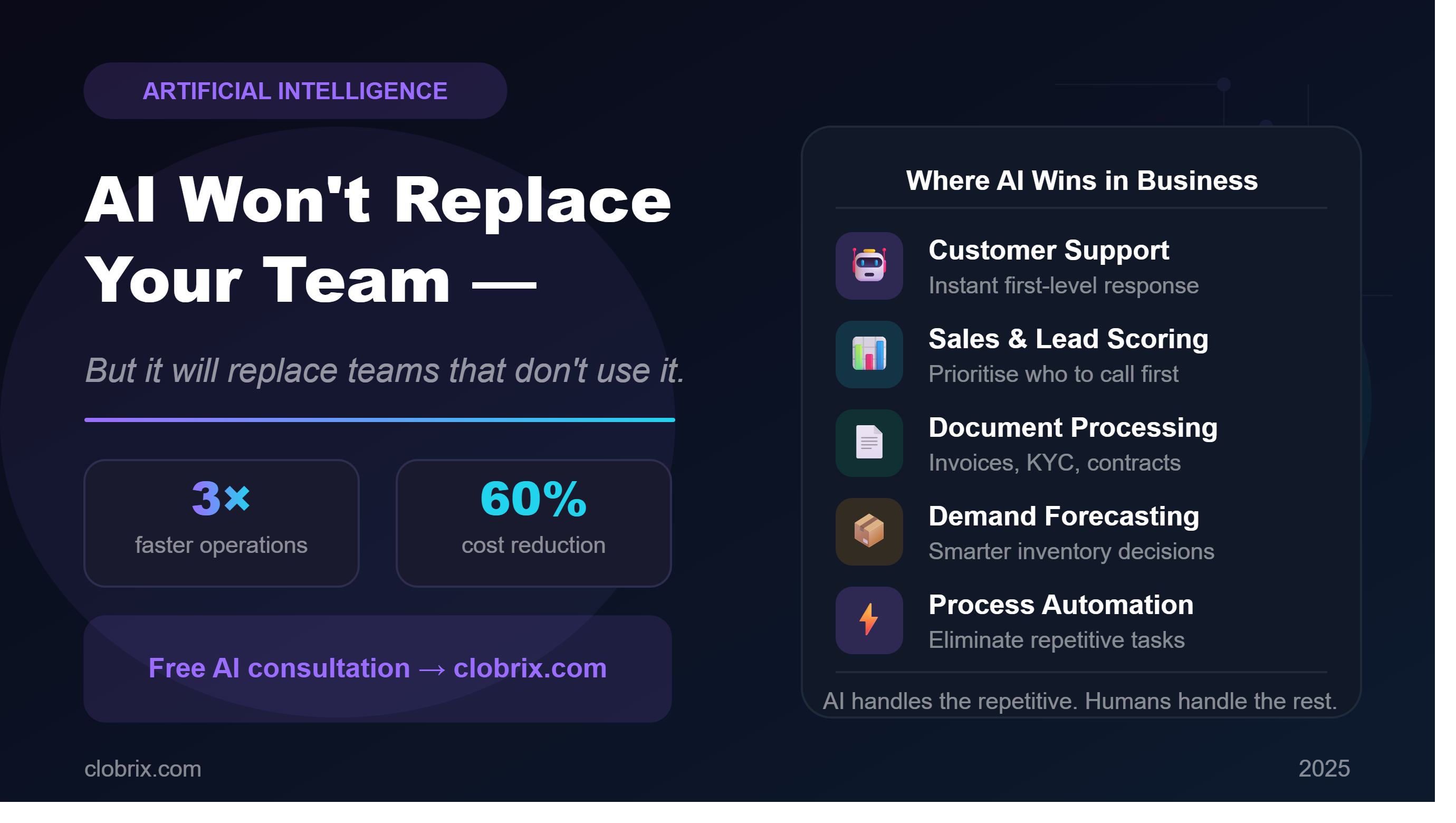
Customer service and support is where most companies start. AI chatbots handle first-level queries — order status, basic product questions, appointment scheduling — which frees human agents to handle complex issues that actually require human judgment. A mid-sized e-commerce company we worked with reduced their first-response time from four hours to under three minutes after implementing an AI support system.
Sales and lead qualification is the second most common application. AI systems score incoming leads based on dozens of factors — company size, engagement behaviour, source, timing — and prioritise them for sales teams. The result is sales teams spending their time on conversations that are actually likely to convert.
Document processing and data extraction is saving finance and operations teams extraordinary amounts of time. Invoice processing, contract review, KYC document verification — tasks that required hours of manual data entry are now automated. The accuracy is high, the speed is remarkable, and the cost is a fraction of the manual alternative.
Demand forecasting and inventory management is proving enormously valuable for manufacturing and retail businesses. AI systems analyse historical sales data, seasonal patterns, and external factors to predict what inventory will be needed and when. The reduction in both stockouts and excess inventory directly improves margins.
What AI Cannot Do — And Why That Matters
The companies that get AI wrong are the ones that try to automate judgment.
AI is excellent at pattern recognition. It is poor at dealing with genuinely novel situations — situations where there is no historical pattern to learn from. It is poor at ethical reasoning. It is poor at understanding context in the way a human naturally does.
A customer who is angry about a legitimate mistake needs empathy, accountability, and a creative solution. An AI system can detect that the customer is angry. It cannot provide genuine empathy. It cannot take real accountability. And its solutions are limited to patterns it has seen before.
The businesses that are using AI well understand this distinction. They use AI to handle the predictable, repeatable, high-volume tasks — and they use humans for the complex, contextual, relationship-driven work that actually builds their brand.
The businesses that get it wrong try to automate too much, alienate customers with robotic interactions, and end up implementing AI in ways that save money in the short term and destroy customer relationships in the long term.
The Competitive Reality of 2025
Here is the uncomfortable truth that this article has been building toward.
AI is not going to replace your team. But businesses that figure out how to use AI effectively are going to be able to do more with smaller teams, respond faster, make better decisions, and operate at lower costs than businesses that do not.
That gap — between businesses that have figured out AI and businesses that have not — is going to widen significantly over the next two to three years.
The companies that will feel this most acutely are not the large enterprises. Large enterprises have entire departments dedicated to digital transformation. The companies that will feel this most acutely are the mid-sized businesses and ambitious startups that are competing on efficiency and speed.
If your competitor is using AI to qualify leads, generate reports, handle customer queries, and process documents — and you are doing all of that manually — they are operating at a fundamentally different cost structure than you are. That is a competitive disadvantage that compounds over time.
Starting With AI — The Practical Path
The most common mistake businesses make when they decide to "implement AI" is trying to do too much at once.
Start with one problem. The best candidates are processes that are:
- High volume — handled many times per day or week
- Repetitive — following a consistent pattern
- Currently taking significant time — eating into capacity you could use elsewhere
- Based on data you already have — historical records, previous examples
Pick that one problem, build or implement a focused AI solution for it, measure the results, and learn from the experience. Then move to the next one.
This approach produces results you can actually see and measure, builds organisational knowledge about how to work with AI, and avoids the expensive mistake of building something large and complicated before you understand what you actually need.
The Question Worth Asking
Here is a useful exercise for any business owner thinking about AI.
Look at your team's work over the last week. Identify every task that was:
Repetitive — done the same way multiple times. Data-heavy — required extracting, processing, or moving data. Time-consuming — took significantly longer than it should. Human-bottlenecked — had to wait for a person to do it before anything else could happen.
Those are your AI opportunities. They are probably generating more work than you realise, costing more than you are tracking, and slowing your business down in ways you have normalised.
AI will not replace your team. But used thoughtfully, it will make your team more capable than you currently think possible.
That is what makes it worth paying attention to.
Clobrix Technologies builds AI-powered applications and automation systems for businesses across India and globally. If you want to explore what AI could do for your specific business, we offer a free initial consultation.