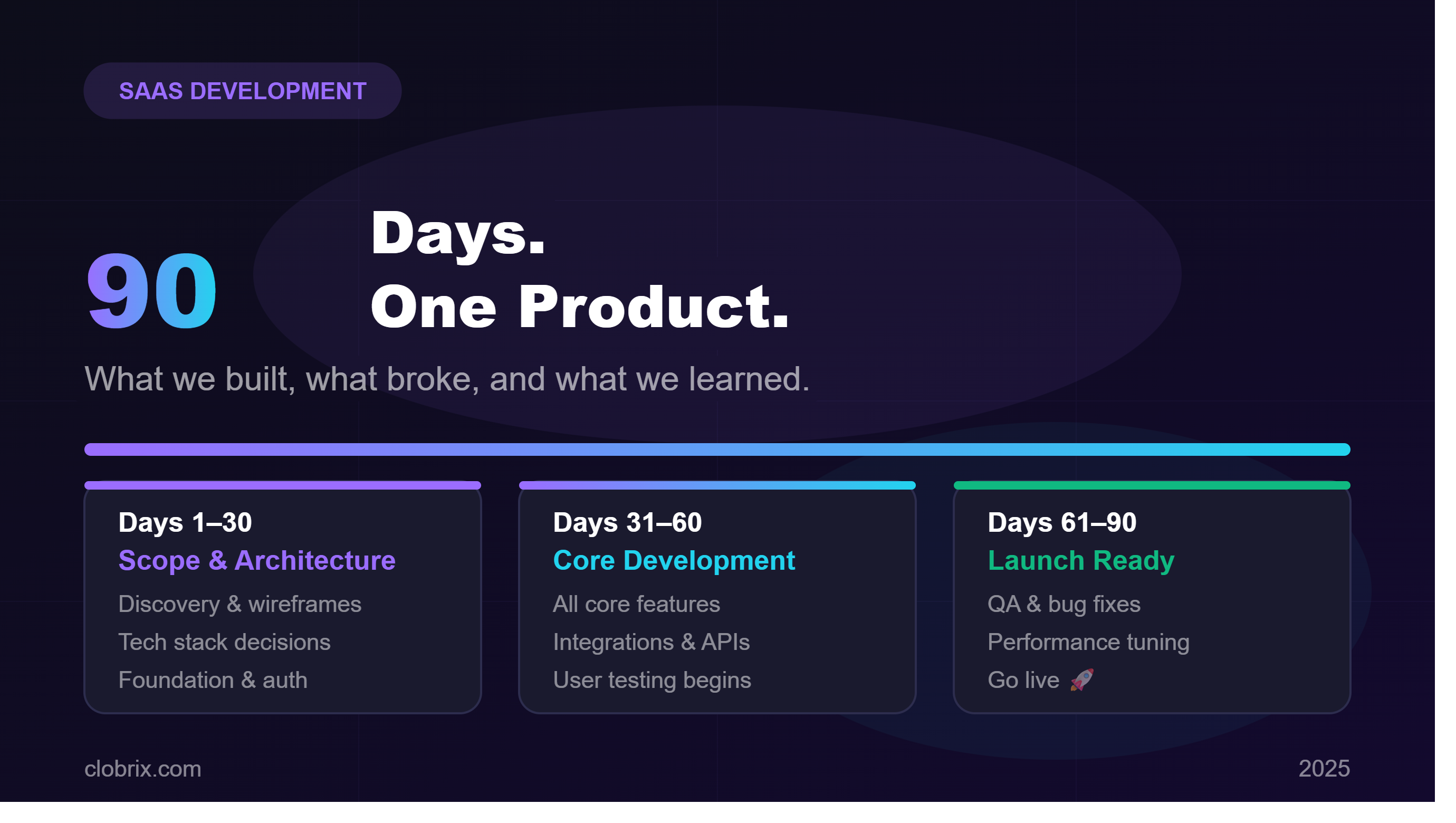

Ninety days is not a lot of time to build a SaaS product.
It is enough time to make about a thousand decisions, write thousands of lines of code, redesign the same screen four times, and discover that the feature everyone agreed was essential in week one is completely unnecessary by week eight.
We have done this more than once. And every single time, we learn something we did not expect to learn.
This is the honest account of what building a SaaS platform from scratch actually looks like — the parts development agencies rarely talk about.
Where It Actually Begins: The Painful Scoping Phase
Every SaaS project starts the same way. The founder has a clear vision. The development team has questions. And somewhere between the vision and the questions, the real product starts to take shape.
The most important work we do before writing a single line of code is scope reduction.
Most founders come to us with a product that would take 18 months to build. Our job — and this is something clients do not always appreciate immediately — is to help them figure out what the product needs to be at launch, not what it will eventually become.
This is the difference between a product that ships and a product that stays in development indefinitely.
For a recent client — a B2B SaaS tool for operations management — the initial brief included 47 features. After two intensive scoping sessions, we launched with 11. The other 36 are now on a prioritised roadmap, being built based on actual user feedback rather than assumptions.
That product is now live, has paying customers, and is generating real revenue. The full 47-feature version would still be in development.
The Technology Decisions That Matter Most
For most SaaS products in the ₹10–50 lakh development budget range, the technology stack matters less than people think — and the architecture matters enormously more.
We build most of our SaaS products on Laravel for the backend. It is not the trendiest choice, but it is the right one for products that need to be shipped quickly, maintained reliably, and scaled without architectural rewrites. Laravel's ecosystem is mature, well-documented, and has solutions for almost every common SaaS requirement out of the box.
For the frontend, the choice between React, Vue, and a server-rendered Blade application depends on the specific product. A simple internal tool with moderate interactivity does not need a full React SPA. A complex, real-time dashboard probably does. We make this decision based on the product requirements, not on what is fashionable.
The decisions that actually determine whether a SaaS product succeeds technically are the ones nobody talks about in the planning phase:
How will you handle multi-tenancy? Will each customer have their own database, or will you share a database with tenant isolation? This decision has enormous implications for data security, performance, and complexity.
How will you structure your subscription and billing? Building billing from scratch is a trap. We use Stripe for almost everything now, but integrating it properly — with webhooks, failed payment recovery, plan changes, and proration — takes more time than most people budget for.
What is your approach to background jobs? Every SaaS product has work that should not happen in a web request — emails, report generation, data imports, third-party API calls. Getting this infrastructure right early saves enormous pain later.
How will you handle file storage? Local storage works in development. It does not work in production when you have multiple servers. This is a decision that needs to be made on day one, not day 60.
The Mid-Point Crisis (It Is Always There)
Around week five or six of a 90-day project, something interesting happens.
The initial excitement has settled. The foundation is built. And suddenly, the team — both ours and the client's — starts to see the real product taking shape, which means they also start to see all the things they got wrong in the planning phase.
Features that seemed essential are now clearly unnecessary. Workflows that seemed simple are revealed to be complex. And the user interface, which looked great in Figma, behaves unexpectedly when real people try to use it.
This is not a failure. This is the process working correctly.
The right response to a mid-point crisis is not to panic and add more time and budget. It is to make decisions quickly, accept that some early assumptions were wrong, and keep moving forward.
The worst thing a team can do at week six is to open up the scope, add features, and try to solve problems that do not exist yet.
What Actually Gets SaaS Products to Market
After building SaaS products across multiple industries and business sizes, the pattern is clear.
The products that launch are the ones where the founder has made peace with launching something incomplete. Not broken — incomplete. There is a difference. Broken means it does not work. Incomplete means it does not have every feature on the roadmap.
Every great SaaS product started as something incomplete that got shipped, improved based on real user feedback, and gradually became what it is today.
The products that never launch are the ones where the search for perfection became the enemy of good enough.
The 90-day SaaS build is not about building a perfect product. It is about building the right foundation quickly, getting it in front of real users, and using what you learn from those users to make it better.
That is what we learned. That is what we keep relearning.
Clobrix Technologies specialises in SaaS product development for startups and businesses across India and globally. If you have a SaaS idea you want to bring to market, let's talk.